Kitchen Scramble: Cooking Game
- 4.2
- Rating
- 10.00M
- Installs
- Free
- Price

 Analysis by App-foxy
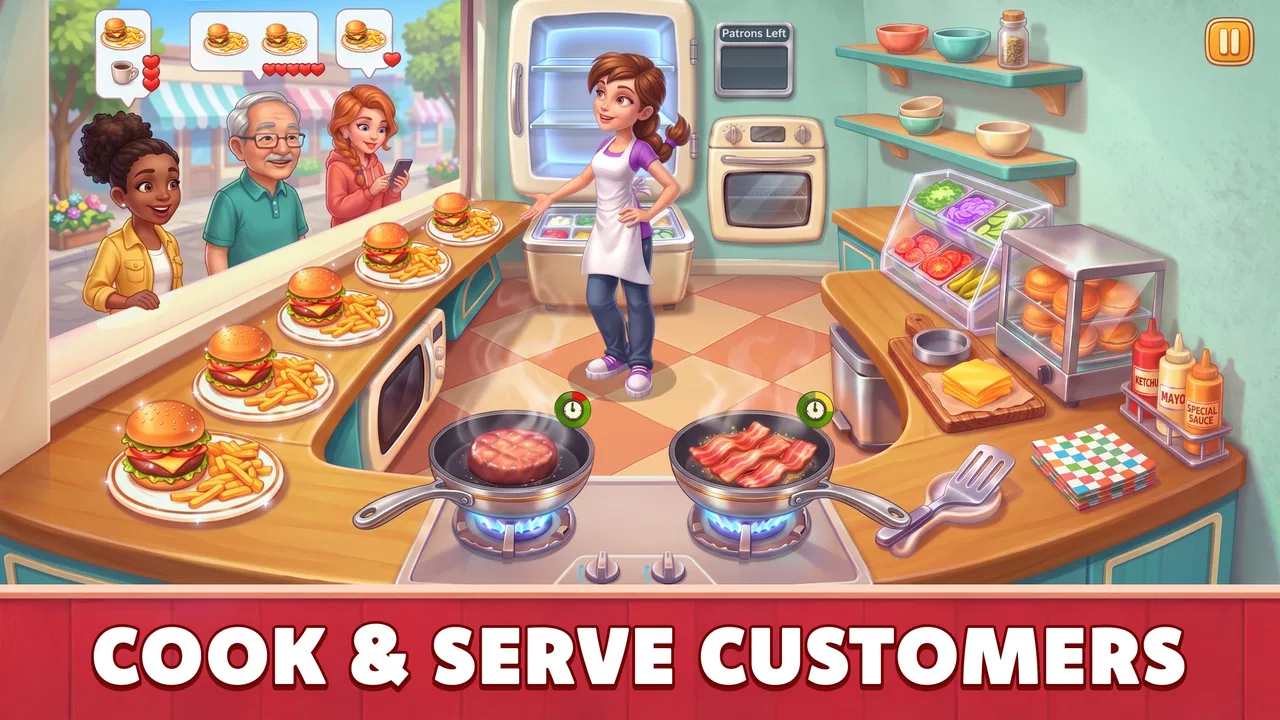
I spent time with Kitchen Scramble: Cooking Game as a casual simulation player, and my first impression was that it is less about decorating a restaurant or building a huge business empire and more about making quick decisions behind a travelling kitchen. You prepare dishes, serve customers, and try to keep the service moving while the game takes Chef Pepper through different parts of the world. That simple setup gives each level a clear purpose: read the order, choose the right action, and avoid letting a small delay turn into a messy service.
It is a free game from Garden City Games, rated for Everyone, and it has built a sizeable audience with a 4.2 average from around 346 thousand ratings and over 10 million installs. Those figures suggest that the format has broad appeal, but they do not tell you whether it suits your habits. In my experience, the important question is whether you enjoy short bursts of pressure and repeated improvement. If you prefer slow, decorative restaurant management, this may feel too focused on serving customers. If you like compact challenges where planning matters as much as speed, it is much easier to recommend.
How the kitchen turns simple orders into meaningful decisions
I find the most satisfying part of the kitchen is learning to make each choice serve more than one purpose: a good move can address the waiting customer while keeping the next order manageable. That makes it worth noticing not just what is urgent, but which action leaves me with the clearest options afterward. The same habit also helps reveal where the game’s familiar rhythm can start to feel limiting.
You May Also Like

 Blood Strike: 2.5 Anniversary
Blood Strike’s Loadouts Turn Every Drop Into a Tactical Gamble
A close look at Blood Strike’s custom loadouts: how fast access to signature weapons reshapes its battle royale rhythm, rewards preparation, and narrows the gap between fights.

 Pandora - Music & Podcasts
Pandora’s Music Is Easy to Start, but Harder to Recover
Pandora’s strength is its low-effort path from a seed to a station. Its weak spot is how much confidence it asks you to place in connection, setup, and quiet recovery.

 8 Ball Pool
 Is Built on Rivalries, Rematches, and Routine
A close look at the rivalries, rematches, shared routines, and unanswered safety questions that turn a quick pool match into a persistent mobile community.

 Samsung Music
’s Quiet Strength Is Playing What You Already Own
Its reach comes less from spectacle than from dependable access to a personal library. That simplicity is both the app’s strongest retention engine and its ceiling.

 AccuWeather: Weather Radar
AccuWeather Review: A Quick, Clear Forecast for Everyday Decisions
For everyday plans, the best forecast is the one you can understand quickly. AccuWeather makes rain timing, radar, and local conditions easy to act on, with a few trade-offs.

 Hill Climb Racing
Why Hill Climb Racing Still Turns Crashes Into One More Run
A tiny car, a bumpy hill and one more upgrade: Hill Climb Racing keeps resurfacing because its simple chaos makes every near-miss feel personal.
More From Our News Desk
View All News


Reading the queue before touching the controls
The most useful habit I developed was pausing mentally before starting a sequence of actions. The obvious temptation is to tap the first ingredient or cooking step that catches my eye, but that can create a poor working order. A better approach is to look at the customers waiting, identify which requests share preparation steps, and then decide what should happen first. Even when a level looks straightforward, the order in which I begin tasks affects how much room I have later.
This is where the simulation category fits well. The game is not asking me to design a realistic kitchen layout, but it does create a small operating problem. I have limited attention, several requests competing for it, and a service flow that becomes harder to manage when I react without a plan. The challenge is approachable because the actions are easy to understand. The decision-making becomes interesting because a fast tap is not always the best tap.
I found that customers should not be treated as isolated orders. A request arriving later can change the value of what I do now. Preparing something useful for one customer may help me serve another more efficiently, while starting an unnecessary action can consume attention at exactly the wrong moment. This makes the game feel closer to queue management than to a simple reflex test.
Choosing a working rhythm instead of chasing speed
Speed matters, but I did not get the best results by trying to move as quickly as possible from the first second. I had more consistent runs when I established a rhythm: inspect the visible demand, begin the most urgent useful task, complete it cleanly, and then reassess. That rhythm is especially helpful for people playing on a small screen, where frantic tapping can make it harder to notice what the next customer needs.
A practical tip is to separate actions into three mental groups: tasks that are immediately required, tasks that prepare for a likely next order, and actions that can wait. That small distinction prevents overcommitting. It also makes the game more comfortable during a short break, because I am not relying entirely on memorized sequences. I can keep checking the situation instead of treating each stage like a fixed script.
The game works well in an everyday scenario such as a quick commute or a few minutes before an appointment. I can play a short session without needing to settle into a long story or remember a complicated control scheme. At the same time, a distracted session is noticeably less satisfying. If I am answering messages or repeatedly switching away, the service flow loses its meaning and mistakes feel more like interruptions than decisions.
Why the travelling-kitchen theme helps
Chef Pepper’s journey gives the cooking tasks a sense of movement. The international setting is not merely a label attached to a generic timer game; it gives the progression a reason to move from one place to another. I enjoyed the feeling that each stage belonged to a broader culinary trip, even though the core activity remains serving customers efficiently.
That theme also makes the game easier to return to. I am not only trying to beat an abstract score. I am moving through a sequence of food-service situations, and that gives small improvements a little more context. The presentation is light enough for casual play, but it still supports the central idea that every stop brings another chance to refine my kitchen routine.
Where risk and reward appear in ordinary play
The main risk is not a dramatic failure; it is allowing several small inefficiencies to accumulate. Taking an action too early, ignoring the order of the queue, or focusing on one customer while another becomes urgent can leave me trying to recover from a problem I created myself. The reward for better planning is a smoother sequence in which each action supports the next.
I particularly liked the trade-off between serving the easiest request immediately and preparing for a more demanding request that may take longer. The easy order offers quick progress and can reduce visible pressure. The longer task may be the wiser choice if it prevents a later bottleneck. Neither decision is always correct, which is what gives the short levels more texture than a simple “tap faster” design.
My advice is to avoid treating every customer as equally urgent. I first look for the request that could cause the most disruption if delayed, then consider whether another order can be completed with almost no extra effort. This is a small form of counterplay against the level’s pressure: instead of accepting the queue as a fixed sequence, I try to shape the sequence through my own priorities.
Spending decisions and the free-to-play trade-off
The game is free to download, but in-app purchases range from $0.99 to $99.99 per item. That matters because the experience is built around repeated play and improvement, so some players may feel tempted to spend when a stage becomes demanding or when progress feels slower than they would like. I recommend deciding in advance whether you want to treat purchases as optional convenience or avoid them completely.
For me, the better value came from improving my approach before considering any purchase. Replaying a difficult section with a different order of actions often taught me more than simply trying to push through it. That does not remove the appeal of optional spending for every player, but it does mean that patient players have a meaningful way to engage with the challenge without immediately turning every obstacle into a payment decision.
Parents should also note the difference between the Everyone age rating and the presence of optional purchases. The content rating makes the game approachable for a broad audience, but younger players may still need guidance around store spending. I would be comfortable recommending it as a family-friendly cooking game, while still treating purchase controls as a separate practical concern.
Adapting when a familiar routine stops working
One of the game’s better qualities is that a method that feels reliable in one situation can become inefficient in another. That encouraged me to adapt rather than memorize. When a level became more demanding, I stopped asking, “What did I do last time?” and started asking, “What is different about this queue?” The change might be the order of requests, the amount of attention required, or the cost of delaying one particular action.
This is also where replaying has real value. A failed attempt is useful when I can identify the first decision that caused the later problem. If I simply repeat the same sequence faster, I usually reproduce the same weakness. If I change the opening move or reserve attention for the more complicated request, the next attempt becomes an experiment rather than a guess.
Players who enjoy optimization may want to keep a simple mental record of what caused each setback. Was the problem poor prioritization, unnecessary preparation, or a tendency to focus on the front customer while ignoring what followed? That kind of self-review is more productive than blaming the controls. The game’s small scale makes these lessons easy to isolate.
Planning for the next few actions
I found a useful middle ground between improvising every tap and planning an entire level in advance. I tried to think two or three actions ahead, while leaving enough flexibility to respond to the queue. Planning too far ahead can be fragile because one unexpected need changes the value of everything that follows. Planning too little creates frantic play. A short horizon keeps the strategy practical.
That approach is especially helpful for new players. Rather than attempting to master every possible order immediately, focus on building a repeatable opening routine and then leave space to adapt. Once the first part of service feels stable, attention can move toward handling the awkward moments near the middle or end of a stage, when earlier choices become visible in the queue.
How depth develops over time
Kitchen Scramble is easy to understand quickly, but its depth comes from execution and adjustment rather than from a large set of complicated systems. I did not need a long tutorial to know what the game wanted from me. The longer-term interest came from noticing how much smoother a stage became after I stopped wasting actions and started treating the queue as a planning problem.
The progression is best suited to players who enjoy incremental mastery. If you want a game that constantly introduces entirely new rules, this may feel narrower. The core loop remains recognizable: prepare food, serve customers, and manage the pressure of keeping service moving. Its strength is that the same basic loop can still test different habits as the situations become less forgiving.
I also think the game works better as a regular short-session title than as an all-day marathon. Playing too long can make the repeated structure feel more obvious, while returning later gives the planning challenge a fresh edge. I often performed better after a break because I came back with a clearer idea of which action had been causing trouble.
Who will enjoy it, and who should choose something else
I would recommend it to players who like casual simulation games with visible goals, quick decision cycles, and a light culinary theme. It is a good fit for someone who wants more involvement than a passive time-filler but does not want a complicated management interface. It can also suit families because the presentation is accessible and the age rating is Everyone.
I would be more cautious about recommending it to someone who wants deep restaurant construction, detailed ingredient economics, or a large creative sandbox. This is not the right choice if your main pleasure comes from arranging furniture, designing menus freely, or watching a business grow through long-term financial planning. A restaurant tycoon game would be a better alternative for those priorities.
It may also disappoint players who dislike repeated attempts. The design rewards learning from mistakes, so progress can feel less comfortable if you expect to clear everything immediately. Likewise, anyone who strongly dislikes free-to-play pressure should decide beforehand whether the optional purchase structure will bother them. The game is most enjoyable when the player accepts that patience and replaying are part of the experience.
How it compares with other cooking games
Compared with decoration-focused cooking apps, this one puts more emphasis on service flow. I spend less time making a restaurant visually expressive and more time deciding what deserves attention next. Compared with fast arcade cooking games, it feels less dependent on pure reflexes because planning the order of actions can prevent frantic recovery later.
It also sits between a simple puzzle and a traditional management game. Like a puzzle, it asks me to find an efficient response to a compact situation. Like a management game, it makes delays and poor prioritization matter. The difference is that the scale stays personal: I am managing the immediate kitchen rhythm rather than a broad business with many layers of administration.
That middle position is its clearest identity. It gives casual players enough strategic texture to think about, while keeping the controls and objective approachable. The trade-off is that players seeking extensive customization or a highly realistic culinary simulation will find the scope limited. I see that limitation as deliberate rather than a flaw, provided the player wants short, focused service challenges.
Current details and practical expectations
Garden City Games released the game on July 30, 2014, and the current version is 11.2.37. It requires Android 7.0 or later. Those details make it worth checking your device before installing, particularly if you are using older hardware or an older operating system. The game’s long presence and large install base also make it feel like an established casual title rather than a brief experiment.
I would still approach the download with realistic expectations. The app is free, but the optional purchase range means the full experience should be judged not only by its opening minutes but also by how comfortable you are with its long-term progression model. If you enjoy earning improvement through repetition, that structure can work. If you want every part of a game to be immediately available without any temptation to spend, a paid cooking game may be a cleaner fit.
My strategy verdict after playing
My strongest recommendation is to play it as a decision game disguised as a cooking game. The food theme makes the actions friendly, but the satisfying part is learning how to control the queue. Start by scanning the requests, choose the action that protects your next few moves, and resist the urge to react to every new customer instantly. When a run goes wrong, identify the first inefficient choice instead of merely tapping faster on the replay.
That mindset reveals more depth than the short store summary suggests. The meaningful reward is not just completing a dish; it is reaching a point where the kitchen feels organized because your choices created that order. The risk is that the repeated structure and optional purchase model may not suit everyone, especially players looking for a creative restaurant builder or a completely pressure-free experience.
Overall, I think this is a solid free simulation for quick sessions and gradual improvement. Its best moments come from balancing immediate service with preparation for what is about to arrive, then adapting when the obvious plan stops working. I would recommend it to a friend who enjoys approachable strategy, cooking themes, and replayable challenges. I would skip it for someone who wants extensive customization or dislikes repeating levels, but for the right player, Kitchen Scramble: Cooking Game is a surprisingly thoughtful way to turn a small kitchen queue into a planning exercise.
FAQs for Kitchen Scramble: Cooking Game
01What is Kitchen Scramble: Cooking Game?
Kitchen Scramble: Cooking Game is a casual time-management game in which you prepare and serve meals to hungry customers. You travel through different locations, operate a food truck, follow recipes, and try to complete orders quickly and accurately. The game combines simple tap-based controls with level objectives, upgrades, and progressively more demanding kitchen challenges.
02Is Kitchen Scramble: Cooking Game free to download and play?
Yes, Kitchen Scramble: Cooking Game can generally be downloaded and played for free on supported mobile devices. However, the game may include optional in-app purchases for coins, boosters, energy, special items, or other conveniences. You can usually progress without paying, although waiting periods, limited resources, and difficult levels may encourage purchases. Check your device store for the current pricing and availability.
03How does the gameplay work?
Gameplay focuses on preparing dishes in the correct order while managing several customer requests at once. You tap ingredients and cooking stations, serve completed meals, and aim to avoid burning food or making customers wait too long. As you advance, recipes become more complex and kitchens introduce additional equipment, ingredients, and objectives that require faster reactions and better planning.
04Can Kitchen Scramble: Cooking Game be played offline?
Some parts of Kitchen Scramble: Cooking Game may work without a constant internet connection, particularly basic cooking levels that have already loaded on your device. Nevertheless, an internet connection may be required for advertisements, cloud synchronization, events, updates, purchases, or certain online features. Offline behavior can vary by version and platform, so it is best to launch the game online before traveling or playing without reliable connectivity.
05Is Kitchen Scramble: Cooking Game suitable for children?
Kitchen Scramble: Cooking Game is generally easy for children to understand because it uses colorful visuals, familiar food themes, and straightforward touch controls. However, parents should review the age rating and supervision settings before allowing younger players to use it. The game may contain advertisements, optional purchases, and mechanics involving limited energy or rewards, so parental controls are recommended to prevent accidental spending.
Pros
- Fun time-management gameplay with increasingly challenging kitchen tasks.
- Large variety of recipes keeps cooking sessions feeling fresh.
- Bright cartoon visuals are friendly and appealing to casual players.
- Simple controls make it easy to start playing on mobile devices.
- Frequent goals and rewards provide motivation to keep progressing.
Cons
- Energy limits can interrupt play and encourage waiting or purchases.
- Later levels may feel difficult without upgrading kitchen equipment.
- Some recipes and upgrades require significant in-game currency.
- The gameplay can become repetitive after extended sessions.
- Ads and promotional offers may appear frequently during progression.

Kitchen Scramble: Cooking Game
Gallery